


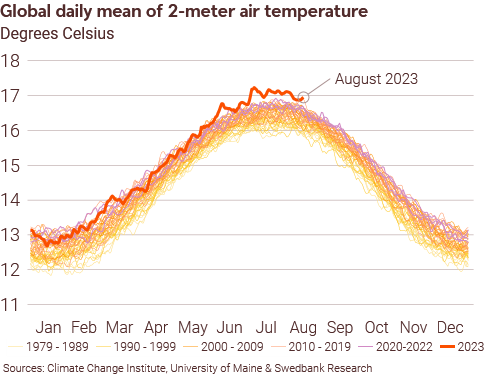
 In early July, the Earth’s average temperature set a new all-time record, shattered three times within the same week. The surge in surface temperature escalates the likelihood of extreme weather events, such as heatwaves, floods, or storms.
- The realised economic losses in the Nordic and Baltic regions have so far been relatively limited within the broader European context. Nevertheless, the greatest risks originate from external sources, such as supply chain disruptions and increased product prices.
- Extreme weather could contribute to higher inflation and prolong the current high inflation setting, making the task for central banks even trickier.
Scientists project that countries bordering the Mediterranean Sea will frequently experience heatwaves exceeding 45 degrees Celsius, with a strong likelihood that temperatures will increasingly surpass the 50-degree Celsius mark by 2100. But how will extreme weather affect us in a broader economic sense? We take a look at this in this analysis.
The escalation of extreme weather events affects our countries’ economies, with variations seen at both regional and national levels. The cumulative direct economic losses from extreme weather events from the 1980s to 2020 reached around EUR 1500 per capita in Denmark, whereas the corresponding amount is approximately EUR 400 in Latvia, Lithuania, Finland, and Sweden.
However, when factoring in the indirect costs, the cumulative annual losses during this period exceeded 8% of Latvia’s GDP in 2020. A comparison across Nordic and Baltic nations highlights that extreme weather has also substantially impacted Lithuania and Denmark. Meanwhile, for the economies of Sweden, Norway, Finland, and Estonia, the impact is considerably less pronounced.
Looking ahead, average yearly losses from natural disasters, incorporating indirect costs, could potentially double by 2040 compared to the early 2000s. Projections suggest potential losses of up to EUR 1.2 billion in Denmark, EUR 0.5 billion in Sweden, and EUR 0.3 billion in Finland.

Tõnu Toompark on kinnisvaraanalüütik, -konsultant ja koolitaja, kelle tegevusvaldkonnad on valdavalt: * elamispindade turg, turutrendid, tehingud, hinnad ning turuülevaated; * uute korterite arendamise mahud, müük, hinnad ja analüüsid; * üürituru pakkumine, tehingud ja hinnad ning üüriinvesteeringud, tasuvusarvutused; * elamispindade kättesaadavus numbrilisena; * koolitused eeltoodud valdkondades. Koolituste valdkonnaga on Tõnu Toompark seotud üle 25 aasta. Ta on avaldanud sadu ja sadu kinnisvarateemalisi analüüse, artikleid ja kommentaare. Tõnu Toompark on läbi viinud koolitusi nii kesk-, kutse-, kõrg-, kui ülikoolides, lisaks mitmetes koolitusettevõtetes. Näiteks Kinnisvarakool, Tallinna Tehnikaülikool, Eesti Ettevõtluskõrgkool Mainor, Estonian Business School, Tartu Ülikool, Tallinna Majanduskool.