



Kinnisvarakool & koolitus: kinnisvaramaakleri täiendkoolitus
Kinnisvarakool: Kinnisvaramaakleri stardiprogramm
Kinnisvarakool & koolitus: Kinnisvaraarenduse praktikum – ideest teostuseni
Kinnisvarakool: Planeerimis-ehitusvaldkonna spetsialisti täiendõppeprogramm
 

Nordecon: 2026 II quarter and 6 months consolidated interim report (unaudited)

NordeconIn the first half of the year, the gradual recovery of the Estonian economy continued, but the economic environment remained affected by geopolitical uncertainty and fluctuations in energy prices. According to the latest published forecasts, Estonia’s 2026 economic growth is expected to reach approximately 2.3–2.4%. Growth is primarily supported by the recovery of domestic demand, public sector investments, and improved financing conditions. In the construction sector, signs of stabilization and moderate recovery are evident. The market is mainly supported by investments related to national defense, infrastructure, and energy facilities, while the building construction segment continues to be characterized by modest investment activity.

The group’s sales revenue increased in both segments compared to the first 6 months of 2025, split between the Buildings and Infrastructure segments at 78% and 22%, respectively. The volume of the Buildings segment grew by 21% compared to H1 2025, while the Infrastructure segment grew by 165%. The group’s gross profitability was 4.7% and operating profitability was 1.9% in H1. Compared to the same period in 2025, profitability has decreased somewhat, but profit has increased on the back of sales revenue growth. The decline in profitability was driven by continuously rising input costs and the structure of the project portfolio, as a result of which the average profit margin of projects in progress during the reporting period was lower than in the comparable period a year earlier. On an annual basis, i.e. compared to 30 June 2025, the group’s order book increased by 7%. Order book volumes have grown in both the buildings and infrastructure segments. Based on the volume of the order book, group management forecasts growth in operating volumes in 2026.

Condensed consolidated interim statement of financial position

€’000 30 June 2026 31 December 2025
ASSETS
Current assets
Cash and cash equivalents 6,093 5,266
Other financial assets 1,078 1,088
Trade and other receivables 46,164 46,348
Prepayments 3,865 3,274
Inventories 40,318 26,022
Total current assets 97,518 81,998
Non-current assets
Other investments 77 77
Other financial assets 2,410 1,810
Trade and other receivables 10,365 10,142
Investment property 3,814 5,517
Property, plant and equipment 13,650 12,234
Intangible assets 14,959 14,922
Total non-current assets 45,275 44,702
TOTAL ASSETS 142,793 126,700
LIABILITIES
Current liabilities
Borrowings 10,713 12,049
Trade payables 65,184 49,569
Other payables 11,057 9,971
Deferred income 8,953 15,249
Provisions 766 3,863
Total current liabilities 96,673 90,701
Non-current liabilities
Borrowings 13,591 5,708
Trade payables 6,061 1,605
Provisions 2,616 5,730
Total non-current liabilities 22,268 13,043
TOTAL LIABILITIES 118,941 103,744
EQUITY
Share capital 14,379 14,379
Own (treasury) shares (660) (660)
Share premium 635 635
Statutory capital reserve 2,554 2,554
Translation reserve 4,718 4,522
Retained earnings 577 141
Total equity attributable to owners of the parent 22,203 21,571
Non-controlling interests 1,649 1,385
TOTAL EQUITY 23,852 22,956
TOTAL LIABILITIES AND EQUITY 142,793 126,700


Condensed consolidated interim statement of comprehensive income

€’000 H1 2026 Q2 2026 H1 2025 Q2 2025 2025
Revenue 126,913 74,910 92,638 53,283 208,281
Cost of sales (120,993) (71,928) (87,188) (49,635) (194,746)
Gross profit 5,920 2,982 5,450 3,648 13,535
Marketing and distribution expenses (212 (136) (169) (86) (433)
Administrative expenses (3,359) (1,612) (3,072) (1,526) (6,814)
Other operating income 182 165 68 16 154
Other operating expenses (59) (46) (160) (126) (6,835)
Operating profit (loss) 2,472 1,353 2,117 1,926 (393)
Finance income 216 105 258 113 499
Finance costs (1,988) (1,019) (1,904) (1,165) (3,464)
Net finance costs (1,772) (914) (1,646) (1,052) (2,965)
Profit (loss) before tax 700 439 471 874 (3,358)
Income tax expense (1) (1) 0 0 (141)
Profit (loss) for the period 699 438 471 874 (3,499)
Other comprehensive income (loss):
Exchange differences on translating foreign operations 196 115 473 569 488
Total other comprehensive income 196 115 473 569 488
TOTAL COMPREHENSIVE INCOME (LOSS) 895 553 944 1,443 (3,011)
Profit (loss) attributable to:
– Owners of the parent 436 334 (134 482 (4,605)
– Non-controlling interests 264 104 605 392 1,106
Profit (loss) for the period 700 438 471 874 (3,499)
Comprehensive income (loss) attributable to:
– Owners of the parent 632 449 339 1,051 (4,117)
– Non-controlling interests 264 104 605 392 1,106
Comprehensive income (loss) for the period 896 553 944 1,443 (3,011)
Earnings per share attributable to owners of the parent:
Basic earnings per share (€) 0.01 0.01 (0.00) 0.02 (0.15)
Diluted earnings per share (€) 0.01 0.01 (0.00) 0.02 (0.15)


Condensed consolidated interim statement of cash flows

€’000 H1 2026 H1 2025
Cash flows from operating activities
Cash receipts from customers 141,317 104,987
Cash paid to suppliers (123,637) (88,153)
VAT paid (2,872) (3,252)
Cash paid to and for employees (10,742) (10,282)
Income tax paid (367) (350)
Net cash from operating activities 3,699 2,950
Cash flows from investing activities
Paid for acquisition of property, plant and equipment (553) (198)
Proceeds from sale of property, plant and equipment 23 394
Loans provided (42) (41)
Repayments of loans provided 2 4
Dividends received 12 0
Interest received 35 61
Other investments (600) (300)
Net cash used in investing activities (1,123) (80)
Cash flows from financing activities
Proceeds from loans received 2,183 783
Repayments of loans received (1,125) (640)
Payments of lease principal (1,489) (1,247)
Lease interest paid (132) (134)
Interest paid (525) (398)
Dividends paid (637) 0
Other payments (3) 0
Net cash used in financing activities (1,728) (1,636)
Net cash flow 848 1,234
Cash and cash equivalents at beginning of period 5,266 8,195
Effect of movements in foreign exchange rates (21) (103)
Change in cash and cash equivalents 848 1,234
Cash and cash equivalents at end of period 6,093 9,326

Financial review

Financial performance

In the first half of 2026, Nordecon delivered a gross profit of €5,920 thousand (H1 2025: €5,450 thousand). Compared to the same period in 2025, the group’s gross profit increased by 9%, driven by revenue growth. However, the gross margin decreased to 4.7% (H1 2025: 5.9%). In the second quarter, the group’s gross profit amounted to €2,982 thousand (Q2 2025: €3,648 thousand) and the gross margin was 4.0% (Q2 2025: 6.8%).

Both segments made a profit during the period. The gross margin of the Buildings segment was 7.1% in the first half of the year and 5.6% in the second quarter, compared with 7.4% and 7.2% in the same periods in 2025. In the first half of 2026, the Infrastructure segment’s gross margin improved year on year, rising to 0.4% (H1 2025: (0.5)%). However, its gross margin for the second quarter decreased, falling from 8.2% in 2025 to 2.7%. Rising input prices and the composition of the project portfolio continued to impact profitability. Consequently, the average profit margin for projects in progress was lower than in the same period last year.

The group’s administrative expenses for the first half of 2026 were €3,359 thousand. Compared to the same period in 2025, administrative expenses increased by around 9% (H1 2025: €3,072 thousand), mainly due to growth in staff costs and expenses on services and materials. The ratio of administrative expenses to revenue (12 months rolling) decreased year on year, declining to 2.9% (H1 2025: 3.8%).

The group’s operating profit for the first half of 2026 amounted to €2,472 thousand (H1 2025: €2,117 thousand) and EBITDA was €3,844 thousand (H1 2025: €3,435 thousand).

The group’s finance income and costs are affected by exchange rate fluctuations in the group’s foreign markets. In the first half of 2026, the Ukrainian hryvnia weakened against the euro by around 2.6% and the Swedish krona weakened against the euro by around 2.5%. As a result, the translation of the loans provided to the group’s Ukrainian and Swedish subsidiaries in euros into the local currencies gave rise to an exchange loss of €166 thousand (H1 2025: an exchange loss of €652 thousand) and an exchange loss of €9 thousand (H1 2025: an exchange gain of €11 thousand), respectively.

The group ended the period with a net profit of €699 thousand (H1 2025: a net profit of €471 thousand). Net profit attributable to owners of the parent, Nordecon AS, amounted to €436 thousand (H1 2025: a net loss of €134 thousand).

Cash flows

In the first half of 2026, the group’s operating activities produced a net cash inflow of €3,699 thousand (H1 2025: an inflow of €2,950 thousand). The items with the strongest impact were cash receipts from customers and cash paid to suppliers, which increased due to revenue growth, amounting to €141,317 thousand (H1 2025: €104,987 thousand) and €123,637 thousand (H1 2025: €88,153 thousand), respectively.

Investing activities resulted in a net cash outflow of €1,123 thousand (H1 2025: an outflow of €80 thousand). Payments made for investments in property, plant and equipment totalled €553 thousand (H1 2025: €198 thousand) and proceeds from the sale of property, plant and equipment amounted to €23 thousand (H1 2025: €394 thousand). Loans provided amounted to €42 thousand (H1 2025: €41 thousand), interest received amounted to €35 thousand (H1 2025: €61 thousand) and investments in long-term deposits totalled €600 thousand (H1 2025: €300 thousand).

Financing activities in the first half of 2026 generated a net cash outflow of €1,728 thousand (H1 2025: an outflow of €1,636 thousand). Proceeds from loans received amounted to €2,183 thousand, consisting mainly of the use of development loans (H1 2025: €783 thousand). Repayments of loans received totalled €1,125 thousand (H1 2025: €640 thousand). Lease payments amounted to €1,489 thousand (H1 2025: €1,247 thousand) and interest payments to €525 thousand (H1 2025: €398 thousand). Dividends paid in the first half of the year amounted to €637 thousand (H1 2025: no dividend payments).

At 30 June 2026, the group’s cash and cash equivalents amounted to €6,093 thousand (30 June 2025: €9,326 thousand).

Key financial figures and ratios

Figure/ratio H1 2026 H1 2025 H1 2024 2025
Revenue (€’000) 126,913 92,638 114,945 208,281
Revenue change 37% (19)% 33% (7.0)%
Net profit (loss) (€’000) 699 471 1,802 (3,499)
Net profit (loss) attributable to owners of the parent (€’000) 436 (134) 1,020 (4,605)
Weighted average number of shares 31,528,585 31,528,585 31,528,585 31,528,585
Earnings per share (€) 0.01 0.00 0.03 (0.15)
Administrative expenses to revenue 2.6% 3.3% 2.9% 3.3%
Administrative expenses to revenue (rolling) 2.9% 3.8% 3.2% 3.3%
EBITDA (€’000) 3,844 3,435 4,690 2,206
EBITDA margin 3.0% 3.7% 4.1% 1.1%
Gross margin 4.7% 5.9% 6.3% 6.5%
Operating margin 1.9% 2.3% 2.8% (0.2)%
Operating margin excluding gain on asset sales 1.9% 2.2% 2.8% (0.2)%
Net margin 0.6% 0.5% 1.6% (1.7)%
Return on invested capital 3.0% 2.0% 6.2% (5.5)%
Return on equity 3.0% 1.7% 7.8% (14.1)%
Equity ratio 16.7% 23.1% 19.2% 18.1%
Return on assets 0.5% 0.4% 1.5% (2.9)%
Gearing 37.8% 15.8% 6.9% 30.7%
Current ratio 1.01 0.91 0.88 0.90
30 June 2026 30 June 2025 30 June 2024 31 Dec 2025
Order book (€’000) 324,374 303,914 178,799 273,060


Performance by geographical market

Revenue generated in Ukraine accounted for approximately 1% of the group’s total revenue in the first half of 2026. Compared to the same period in 2025, revenue generated in Ukraine, as well as its share of the group’s total revenue, decreased. This was primarily due to the extremely challenging conditions in the country. At the start of the year, frequent power cuts and severe winter weather hindered work on construction sites and in building material production. Labour shortages are also becoming an increasingly serious problem. No revenue was generated in Sweden because the group had no construction contracts in progress in that market.

H1 2026 H1 2025 H1 2024 2025
Estonia 99% 98% 98% 98%
Ukraine 1% 2% 2% 2%


Performance by business line

Segment revenues

The group’s goals include maintaining a balance between the revenues of its two main operating segments (Buildings and Infrastructure) if market conditions permit. This helps diversify risk and provides better opportunities to continue construction activities in challenging market conditions, when volumes in one subsegment decline sharply, while volumes in another start to grow more rapidly.

The group’s revenue for the first half of 2026 was €126,913 thousand, approximately 37% higher than in the first half of 2025, when revenue amounted to €92,638 thousand. The Buildings segment generated revenue of €99,078 thousand and the Infrastructure segment generated revenue of €27,815 thousand. The corresponding figures for the first half of 2025 were €82,127 thousand and €10,501 thousand, respectively. Both segments increased their revenue: the Buildings segment by 21% and the Infrastructure segment by 165%. In the light of the size and structure of the group’s order book, the growth rates were in line with expectations.

Revenue by operating segment H1 2026 H1 2025 H1 2024 2025
Buildings 78% 89% 87% 81%
Infrastructure 22% 11% 13% 19%


Subsegment revenues

Currently, most of the revenue in the Buildings segment comes from the construction of public and commercial buildings. During the period, revenue generated by the public buildings subsegment increased by around 66% year on year. Revenue from the industrial and warehouse facilities subsegment also increased, although the number of projects in progress remains small. Meanwhile, revenue generated by the commercial buildings and apartment buildings subsegments decreased by around 5% and 56%, respectively.

During the period, the largest projects in the public buildings subsegment were the construction of Tiskre School in the Harku rural municipality, as well as the design and construction of the Loodusmaja (Nature Hub) building and the new Television Building for Estonian Public Broadcasting in Tallinn. Work on projects for the Estonian Centre for Defence Investments continued. The construction of barracks in Tapa was completed.

The largest projects in the commercial buildings subsegment were the construction of a commercial building at Väike-Turu 7 in Tartu, the LEED Gold compliant Uusküla spa hotel on the northern shore of Lake Peipus in the Alutaguse rural municipality, and a spa hotel and a swimming complex in Viljandi.

In the apartment buildings subsegment, the group is not currently carrying out any large-scale construction projects for third parties and the main revenue source is property development. In the first half of 2026, the amount of relevant revenue decreased to €3,549 thousand (H1 2025: €6,781 thousand). During the period, work continued on the construction of phase 2 of the Seileri Kvartal housing estate in Pärnu (https://seileri.ee), the Tammepärja Kodu housing estate in the Tammelinn district of Tartu (https://tammelinn.ee), and the Pärnasalu residential development project on the outskirts of Tartu (https://parnasalutee.ee). When carrying out our own development activities, we carefully monitor potential risks in the housing development market.

Buildings segment H1 2026 H1 2025 H1 2024 2025
Public buildings 62% 46% 68% 52%
Commercial buildings 32% 41% 20% 39%
Apartment buildings 4% 12% 9% 8%
Industrial and warehouse facilities 2% 1% 3% 1%

In the first half of 2026, most of the revenue generated by the Infrastructure segment came from road construction and maintenance. Compared to the same period last year, the subsegment’s revenue increased nearly threefold. The largest projects were the construction of the Rail Baltica main line railway infrastructure, including the Hagudi–Alu section of stage III in Rapla County and the Selja–Tootsi section of stage I in Pärnu County, and the construction of the Päädeva–Orgita road section on km 62.2–64.8 of national road no. 4 (E67), Tallinn–Pärnu–Ikla.

Infrastructure segment H1 2026 H1 2025 H1 2024 2025
Road construction and maintenance 95% 70% 93% 87%
Other engineering 5% 30% 7% 13%


Order book

At 30 June 2026, the group’s order book (backlog of contracts signed but not yet performed) stood at €324,374 thousand, reflecting a 7% increase year on year. In the first half of the year, we signed new contracts for €181,652 thousand (H1 2025: €172,236 thousand), of which €25,864 thousand in the second quarter (Q2 2025: €60,960 thousand).

30 June 2026 30 June 2025 30 June 2024 31 Dec 2025
Order book (€’000) 324,374 303,914 178,799 273,060

At 30 June 2026, the Buildings and Infrastructure segments accounted for 71% and 29% of the group’s total order book, respectively (30 June 2025: 70% and 30%, respectively). Compared to 30 June 2025, the order book of the Buildings segment grew by 8% and that of the Infrastructure segment by 3%. In the order book of the Buildings segment, the largest contributor is the public buildings subsegment, which accounts for 74% of the total. A major share of the contracts secured by the subsegment have been awarded by the Estonian Centre for Defence Investments. The order book of the Infrastructure segment has grown primarily through large-scale contracts relating to Rail Baltica as well as a contract with the Estonian Transport Administration for the construction of the Päädeva–Orgita and Haimre sections of the Tallinn–Pärnu–Ikla road.

The contracts of the Rail Baltica project and the road construction projects financed by the European Cohesion Fund through the Estonian Transport Administration have revitalised the infrastructure sector. However, this has not fully offset the underfunding of road construction. The overall volume of public investment in building construction has declined. The market continues to be supported mainly by the defence sector. Although there has also been a revival in the private sector, tendering processes often last for months, and projects are sometimes put on hold for years due to high construction costs or a lack of customer interest.

Major contracts secured in the first half of 2026 include:

  • Construction of the first building and the related outdoor areas of Park Rae, a logistics and light industrial park in Rae rural municipality, with an approximate cost of €15,800 thousand.
  • Construction of a new school building for Helen’s School in Põhja-Tallinn, with an approximate cost of €12,600 thousand.
  • Construction of a building and infrastructure for AS Tallinna Vesi at the Ülemiste Water Treatment Plant site in Tallinn, with an approximate cost of €11,800 thousand.
  • Construction of supporting infrastructure for the Estonian Centre for Defence Investments in Pärnu County, with an approximate cost of €110,400 thousand.
  • Year-round maintenance of national roads in Lääne County in the period 2026–2031, with an approximate cost of €7,900 thousand.
  • Year-round maintenance of national roads in Hiiu County in the period 2026–2031, with an approximate cost of €4,000 thousand.
  • Reconstruction and extension of Kotka Health Centre at Kotka 12 in Tallinn, with an approximate cost of €4,400 thousand.

Based on the size of the group’s order book and the general outlook for the economy and the construction market, the group’s management team expects business volumes to increase in 2026. In a highly competitive environment, management has avoided taking unjustified risks that could materialise during contract execution and adversely affect the group’s results. Our main focus is on assessing and mitigating the risks arising from market changes, particularly rising input costs. We also prioritise managing fixed costs, increasing productivity, and executing pre-construction and design activities effectively to leverage our professional competitive advantages.

People

Employees and staff costs

The average number of the group’s employees (at the parent and the subsidiaries) in the first half of 2026 was 453, including 294 engineers and technical professionals (ETP). Compared to the same period last year, the number of employees increased by around 8%.

Average number of employees at group companies (the parent company and the subsidiaries):

H1 2026 H1 2025 H1 2024 2025
ETPs 294 267 282 275
Workers 159 151 148 156
Total average 453 418 430 431

The group’s staff costs for the first half of 2026, including all taxes, were €11,051 thousand compared with €9,221 thousand in the first half of 2025. Staff costs grew by roughly 20% year on year due to a general pay rise and an increase in the headcount.

In the first half of 2026, the service fees of the members of the council of Nordecon AS totalled €135 thousand and the related social security charges amounted to €45 thousand (H1 2025: €106 thousand and €35 thousand, respectively).

The service fees of the members of the board of Nordecon AS totalled €290 thousand and the related social security charges amounted to €96 thousand (H1 2025: €281 thousand and €93 thousand, respectively).

Labour productivity and labour cost efficiency

We measure the efficiency of our operating activities using the following productivity and efficiency indicators, which are based on the number of employees and the staff costs incurred:

H1 2026 H1 2025 H1 2024 2025
Nominal labour productivity (rolling), (€’000) 540.7 469.7 553.9 483.3
Change against the comparative period, % 15.1% (15.2)% 13.4% (6.0)%
Nominal labour cost efficiency (rolling), (€) 10.5 8.7 11.0 9.8
Change against the comparative period, % 20.7% (21.3)% 0.4% 5.4%

The group’s labour productivity and labour cost efficiency increased year on year, as revenue growth exceeded the increase in the number of employees and staff costs.

nordecon-interim-report-q2-2026

NCN investor presentation Q2_2026

Kinnisvarakool & koolitus: Eluruumi üürimise praktikum – lepingud, probleemid ja üürileandja õiguste kaitse

Merko: 2026 6 months and II quarter consolidated unaudited interim report

MerkoCOMMENTARY FROM MANAGEMENT

Merko Ehitus generated revenue of EUR 93 million in the second quarter of 2026 and EUR 150 million in the first half of the year. Net profit amounted to EUR 8.5 million for the second quarter and EUR 12.8 million for the first six months of 2026. As of the end of the first half of the year, the company’s secured order-book reached an all-time high of EUR 836 million.

According to the management of Merko Ehitus, there was an increase in activity in both the construction services and development segment in the second quarter. Several large-scale projects secured last year entered a more active construction phase, which was reflected in Merko’s revenue figures. In addition, more than twice as many apartments were delivered to customers in the second quarter as in the first quarter of this year. The increase in construction input prices that anticipated in the first quarter has materialised, and there are currently no developments in the economy or global politics that would suggest any easing of price pressures. There were no unexpected changes in the construction and real estate markets during the second quarter, and all of Merko’s home markets performed in line with expectations.

In early July, completed all preparatory stages required for the development of the Rūdninkai defence force campus project. The contract entered into full force, and construction activities have now commenced in full scale. The construction cost of the two phases exceeds 370 million euros in total, and the project’s contribution to revenue will increase significantly in the coming quarters. In the second quarter, signed new construction contracts worth approximately 80 million euros, including the main building, an event center and infrastructure in Krulli quarter in Tallinn.  As of the end of the first half of the year, the group’s companies secured order-book reached an all-time high of EUR 836 million.

Following a prolonged period of growth, activity in Vilnius’s new apartment market has moderated somewhat, while the pace of signing new presale agreements has picked up in Riga. During the second quarter, group launched the construction of more than 160 apartments in Riga, including the Pētersala residential development, which incorporates architecturally significant heritage buildings, as well as the second phase of the Magnolijas development. The market for new residential developments in Tallinn is moving at a pace similar to last year. Across all Merko’s home markets, customers remain highly price-sensitive, with the majority of transactions involving more affordable apartments.

During the first six months of the year, Merko delivered 120 apartments and five commercial units to buyers and launched the construction and sales of 204 apartments and four commercial units. As of the end of the first half of the year, Merko had a total of 1,253 apartments under construction and completed, of which approximately 40% are covered by presale agreements. In the second quarter of 2026, major development projects included Uus-Veerenni, Noblessner and Lahekalda in Tallinn, Õielehe near Tallinn, and Erminurme and Leedri in Tartu; Lucavsala, Arena Garden Towers and Mežpilsēta in Riga; and Vilnelės Skverai and Šnipiškių Urban in Vilnius.

In Estonia, the group’s larger construction projects in progress during the second quarter of 2026 included the City Plaza 2 and Viktor Masing office buildings, the Kullo Hobby Centre in Tallinn, the National Defence Building in Tartu, a hotel and event centre in Pärnu, the Rail Baltica Ülemiste passenger terminal, and the fourth stage of the Rail Baltica main line in Harju County, including the Tallinn–Pärnu section. In Lithuania, the major projects under construction were wind farm infrastructure facilities in the Pagėgiai and Telšiai districts and the Rūdninkai military campus. In Latvia, the group was engaged in the construction of military campuses, a student hotel in Riga, and wind farm infrastructure facilities in the Smiltene municipality.

OVERVIEW OF THE II QUARTER AND 6 MONTHS RESULTS

PROFITABILITY

2026 6 months’ pre-tax profit was EUR 10.8 million and Q2 2026 was EUR 9.1 million (6M 2025: EUR 23.5 million and Q2 2025 was EUR 11.9 million), which brought the pre-tax profit margin to 7.2% (6M 2025: 14.0%).

Net profit attributable to shareholders for 6 months 2026 was EUR 12.8 million (6M 2025: EUR 21.7 million) and for Q2 2026 net profit attributable to shareholders was EUR 8.5 million (Q2 2025: EUR 11.2 million). 6 months net profit margin was 8.6% (6M 2025: 12.9%).

REVENUE

Q2 2026 revenue was EUR 92.7 million (Q2 2025: EUR 82.6 million) and 6 months’ revenue was EUR 149.9 million (6M 2025: EUR 167.9 million). 6 months’ revenue decreased by 10.7% compared to same period last year. The share of revenue earned outside Estonia in 6 months 2026 was 41.2% (6M 2025: 43.8%).

SECURED ORDER BOOK

As of 30 June 2026, the group’s secured order book was EUR 835.7 million (30 June 2025: EUR 443.8 million). In 6 months 2026, group companies signed contracts in the amount of EUR 486.4 million (6M 2025: EUR 223.1 million). In Q2 2026, new contracts were signed in the amount of EUR 79.6 million (Q2 2025: EUR 172.6 million).

REAL ESTATE DEVELOPMENT

In 6 months 2026, the group sold a total of 120 apartments; in 6 months 2025, the group sold 222 apartments. The group earned a revenue of EUR 27.6 million from sale of own developed apartments in 6 months 2026 and EUR 44.9 million in 6 months 2025. In Q2 of 2026 a total of 84 apartments were sold, compared to 101 apartments in Q2 2025, and earned a revenue of EUR 20.6 million from sale of own developed apartments (Q2 2025: EUR 20.2 million).

CASH POSITION

At the end of the reporting period, the group had EUR 39.6 million in cash and cash equivalents, and equity of EUR 251.1 million (57.4% of total assets). Comparable figures as of 30 June 2025 were EUR 25.9 million and EUR 242.3 million (60.1% of total assets), respectively. As of 30 June 2026, the group’s net debt was EUR 29.6 million (30 June 2025: negative EUR 1.1 million).

CONSOLIDATED STATEMENT OF COMPREHENSIVE INCOME

unaudited
in thousand euros

2026
6 months
2025
6 months
2026
II quarter
2025
II quarter
2025
 12 months
Revenue 149,893 167,882 92,670 82,646 310,941
Cost of goods sold (132,508) (138,811) (80,761) (68,488) (255,081)
Gross profit 17,385 29,071 11,909 14,158 55,860
         
Marketing expenses (2,724) (2,701) (1,395) (1,426) (5,823)
General and administrative expenses (7,289) (8,747) (4,072) (4,472) (17,478)
Other operating income 1,244 1,083 736 522 2,285
Other operating expenses (257) (96) (135) (55) (501)
Operating profit 8,359 18,610 7,043 8,727 34,343
           
Finance income/costs 2,428 4,901 2,045 3,184 10,425
 incl. finance income/costs from joint ventures 2,451 4,844 2,133 3,343 10,381
interest expense (359) (395) (186) (185) (836)
foreign exchange gain (loss) 176 (14) (28) (129) (18)
other financial income (expenses) 160 466 126 155 898
Profit before tax 10,787 23,511 9,088 11,911 44,768
           
Corporate income tax expense 2,056 (1,835) (588) (695) (4,850)
Net profit for financial year 12,843 21,676 8,500 11,216 39,918
Other comprehensive income, which can subsequently be classified in the income statement          
Currency translation differences of foreign entities (143) 7 22 66 20
Comprehensive income for the period 12,700 21,683 8,522 11,282 39,938
Earnings per share for profit attributable to equity holders of the parent (basic and diluted, in EUR) 0.73 1.22 0.48 0.63 2.26

CONSOLIDATED STATEMENT OF FINANCIAL POSITION

unaudited
in thousand euros

30.06.2026 30.06.2025 31.12.2025
ASSETS
Current assets      
Cash and cash equivalents 39,593 25,862 41,424
Short-term deposits 6,000 23,000 18,000
Trade and other receivables 59,491 75,989 43,658
Prepaid corporate income tax 486 934 1,347
Inventories 245,853 196,552 219,812
  351,423 322,337 324,241
Non-current assets
Investments in joint ventures 29,408 26,415 31,957
Other shares and securities 80 80 80
Other long-term loans and receivables 20,109 18,645 20,658
Deferred income tax assets 3,221 4,789 2,874
Investment property 11,174 12,475 12,395
Property, plant and equipment 21,770 18,171 22,117
Intangible assets 669 593 714
86,431 81,168 90,795
 
TOTAL ASSETS 437,854 403,505 415,036
LIABILITIES
Current liabilities
Borrowings 7,830 9,712 3,079
Payables and prepayments 95,921 112,484 95,920
Income tax liability 111 112 510
Deferred income from government grant 5 – 2
Short-term provisions 11,494 9,165 10,426
115,361 131,473 109,937
Non-current liabilities
Long-term borrowings 61,339 15,018 30,012
Deferred income tax liability 3,923 6,623 7,448
Other long-term payables 6,090 8,080 7,073
71,352 29,721 44,533
 
TOTAL LIABILITIES 186,713 161,194 154,470
EQUITY
Share capital 7,929 7,929 7,929
Statutory reserve capital 793 793 793
Currency translation differences (164) (34) (21)
Retained earnings 242,583 233,623 251,865
TOTAL EQUITY 251,141 242,311 260,566
 
TOTAL LIABILITIES AND EQUITY 437,854 403,505 415,036

Interim report is attached to the announcement and is also published on NASDAQ Tallinn and Merko’s web page (group.merko.ee).

Merko_Ehitus_2026_6M_interim_report

Kinnisvarakool & koolitus: Kinnisvaramaakleri persoonibränd ja digitaalne turundus

Citadele panga ekspert: enne kallimaga kodulaenu võtmist tuleb mustad stsenaariumid läbi rääkida

Citadele BankCitadele panga statistikast selgub, et ligi pooled kodulaenudest sõlmitakse kahepeale. Enne elukaaslasega laenu võtmist on oluline läbi mõelda nii tagasimaksmise detailid kui ka olukord, kui kõik ei lähe plaanipäraselt.


Kui hakatakse ühist eluaset hankima, seisavad paljud paarid sageli küsimuse ees, kas võtta kodulaen koos või üksi. Koos kodulaenu võttes on paari laenuvõimekus suurem, mis tähendab ka suuremat valikuvabadust erineva hinnaga korterite vahel. „Nii saab paar lubada näiteks suuremat kodu, mugavamat asukohta ja elamist, mis vastab paremini nende vajadustele,“ ütles Citadele panga kodulaenu ja klienditeeninduse valdkonna juht Tiina Sooba.

Citadele panga statistikast selgub, et veidi alla poolte kodulaenudest võetakse koos partneriga. Selle aasta jooksul Citadele panga Eesti filiaalis sõlmitud kodulaenudest on 41% sõlmitud koos kaastaotlejaga. Kui lätlased ostavad kodu suurema tõenäosusega üksi, – sellel aastal sõlmitud kodulaenudest 38% on kaastaotlejaga – siis leedukad on partneriga kodu ostmise poolest Baltikumis esikohal. Seal on vastav näitaja 48%. “Erinevustes on suur roll kinnisvara hindadel,” selgitas Sooba. “Lätis, sealjuures ka Riias, on rohkem vanemat ning Eesti ja Leeduga võrreldes odavamat kinnisvara, mistõttu on seal lihtsam ka üksi endale sobiv eluase leida.” Seda kinnitab ka laenustatistika: kaastaotlejaga võetud keskmine kodulaenusumma on Lätis võrreldes Eestiga poole väiksem (Lätis alla 109 000 euro, Eestis ligi 220 000 eurot).

Mõlemad vastutavad laenu eest võrdselt

Kaastaotleja ja põhitaotleja peavad juba enne laenu sõlmimist omavahel kokku leppima, kas nad panustavad laenumakse tasumisse võrdselt või jagavad kulutused omavahel kuidagi teisiti. Tuleb aga silmas pidada, et vastutus laenu tasumise eest lasub mõlemal laenuvõtjal solidaarselt. “Seda varianti, et näiteks üks maksab laenumaksetest tagasi 75% ja teine 25% ning sellega kaastaotleja kohustused lõppevad, ei ole,” selgitas Sooba. Oluline asi, mida tuleb silmas pidada, on tema sõnul see, et põhitaotleja konto on seotud laenuga ning sealt tehakse laenumakseid.

“Üldjuhul saavad kahekesi laenu taotleda elukaaslased või abikaasad, harvem on kaastaotlejateks teised perekonnaliikmed nagu emad ja isad, kuna kuulutakse erinevatesse leibkondadesse,” lisas Sooba. Sealjuures ei ole panga silmis vahet, kas kodulaenu taotlevad koos abikaasad või elukaaslased – laenu tingimused sõltuvad paari sissetulekutest ja olemasolevatest kohustustest.

Plaan mustadeks stsenaariumiteks

Sooba paneb südamele, et enne ühise kodulaenu sõlmimist tuleb kaaslasega laenu tasumine ja erinevad stsenaariumid läbi rääkida. „Kui peaks juhtuma, et jäädakse erinevatel põhjustel pangale võlgu, siis vastutavad mõlemad laenajad võrdselt ning mõlemate isikute kohta kantakse teave maksehäireregistrisse. See võib takistada tulevikus mõne muu laenu või liisingu saamist,“ selgitas Sooba. Seetõttu tasub enne ühise laenu võtmist panna paika plaan olukordadeks, kus muud kulud kasvavad märkimisväärselt, euribor suureneb või ühe partneri sissetulek väheneb või kaob sootuks.

Samuti tasub ennetavalt arutada, mida teha lahkumineku korral. „On halb, kui pingete tõttu kodulaenu tasumine viibib ning võlad kuhjuvad. Kindlasti tuleb kaastaotlejal kodu ostes jälgida, et temast saaks ka kinnisvara omanik. Lahkumineku korral jääb kinnisvara vormistatud omanikule, ent kohustus laenu edasi tasuda mõlemale,” ütles Tiina Sooba. Kui tekivad probleemid ja on näha,, et laenumaksete tasumine hakkab muutuma keeruliseks, tuleb sellest kohe pangale märku anda.

Kaastaotlejal tasub hoida end kursis laenu tasumisega. “Kui tekib kahtlus laenu tagasimaksmise osas, kaastaotlejal alati võimalus pangale kirjutada ja küsida laenu tasumise seisu,” lisas Sooba.

Kinnisvarakool & koolitus: Kinnisvara müük praktikas – kliendi leidmisest eduka tehinguni

EIS: Euronews: Eesti nimetati maailma parimaks kolimissihtkohaks

EIS Ettevõtluse ja Innovatsiooni SihtasutusGlobaalne ümberasumise indeks (The Global Relocation Index) vaatleb selliseid näitajaid nagu üldine elukallidus, tänavaohutus, õhukvaliteet ja kliima.

Äsja avaldati uus indeks, mis reastab parimad riigid ja territooriumid, kuhu 2026. aastal kolida ning Eesti on selle nimekirja tipus.

Eesti oli maailmas esikohal tänu oma panganduse infrastruktuurile, ärivõimalustele ja mittekodanike omandiõigustele.

Igal aastal teise kvartali lõpus avaldatav indeks hindab 192 riiki 24 näitaja alusel, mis on jaotatud nelja kategooriasse: finants- ja maksundus, elamiskõlblikkus ja tervis, turvalisus ja stabiilsus ning sisseelamine ja võimalused.

Indeks kasutab mitmeid andmeallikaid ja eksperthinnanguid. Näiteks üldise elukalliduse osas vaatas sõltumatu konsultatsioonifirma Rumavi nii Maailmapanga ICP hinnataseme andmeid (PPP) kui ka Merceri elukalliduse uuringut, samas kui poliitilise stabiilsuse osas kaasati 2025. aasta globaalne rahuindeks ja Maailmapanga WGI valitsuse efektiivsuse indeks, mille kaal oli mõlemal 50%.

Igas mõõdikus hinnatakse riiki 100 punkti skaalal. Eesti sai valuuta ja panganduse eest hindeks 99 punkti 100-st, ärivõimaluste eest 96 punkti, eluaseme taskukohasuse eest 82 punkti, rohealade eest 86 punkti ja tänavaohutuse eest 77 punkti.

Kõige halvem näitaja oli kliima, mis sai külmade ja pimedate talvede tõttu 20 punkti 100-st.

Parimad riigid ja territooriumid, kuhu kolida üle maailma on:

  1. Eesti
  2. Singapur
  3. Malaisia
  4. Portugal
  5. Taiwan
  6. Leedu
  7. Hongkong
  8. Saint Kitts ja Nevis
  9. Tšehhi
  10. Malta
Kinnisvarakool: Ehitusjärelevalve praktikas – ehitise ja ehitamise kontrollimine

Statistikaamet: Tööstusettevõtete tootmine vähenes juunis viiendat kuud järjest

Statistikaamet / Statistics EstoniaStatistikaameti andmetel tootsid tööstusettevõtted 2026. aasta juunis püsivhindades 4,6% vähem toodangut kui eelmisel aastal samal ajal. Tööstuse kolmest sektorist kasvas toodang mäetööstuses 26,7%, kahanes aga energeetikas 12,6% ja töötlevas tööstuses 5,3%.
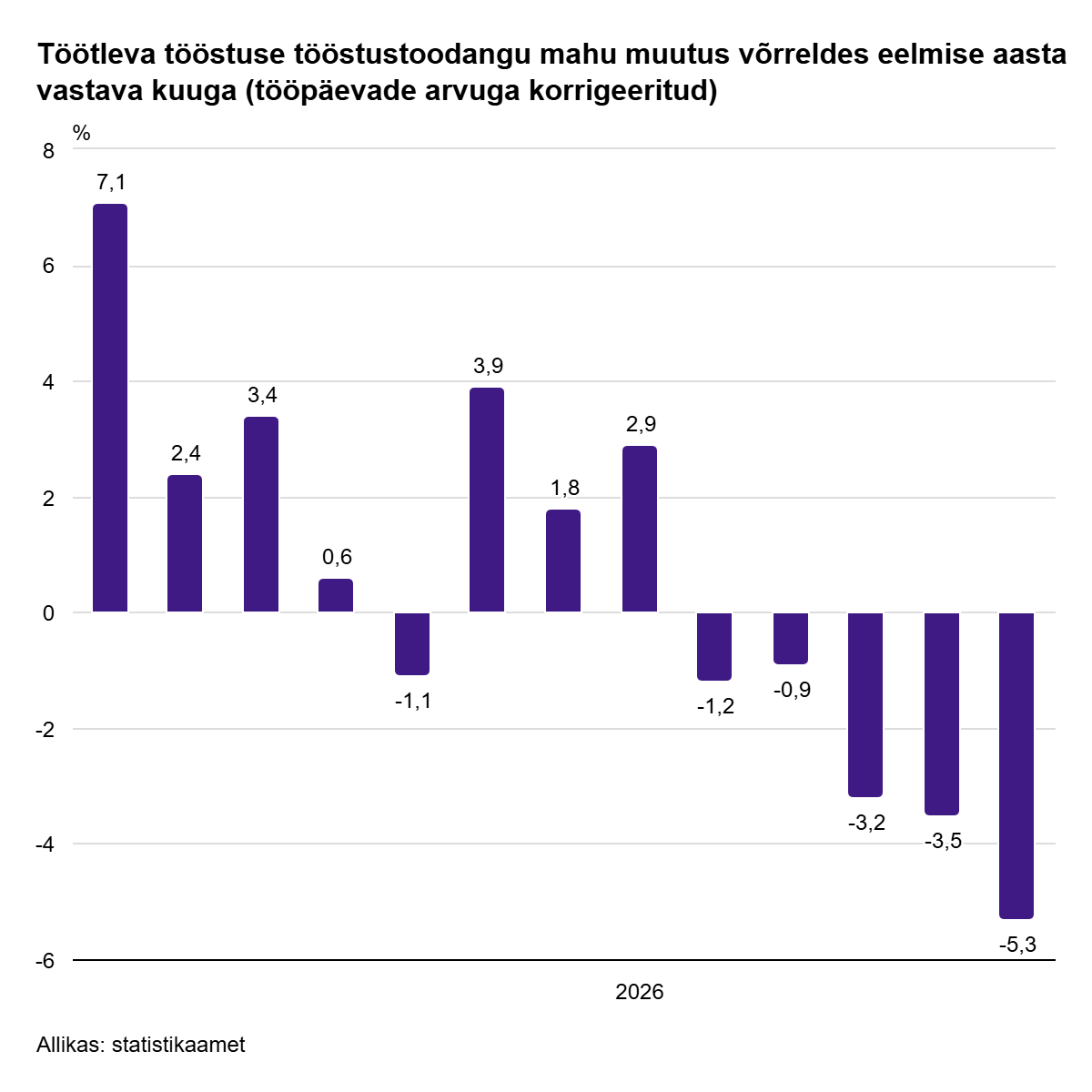
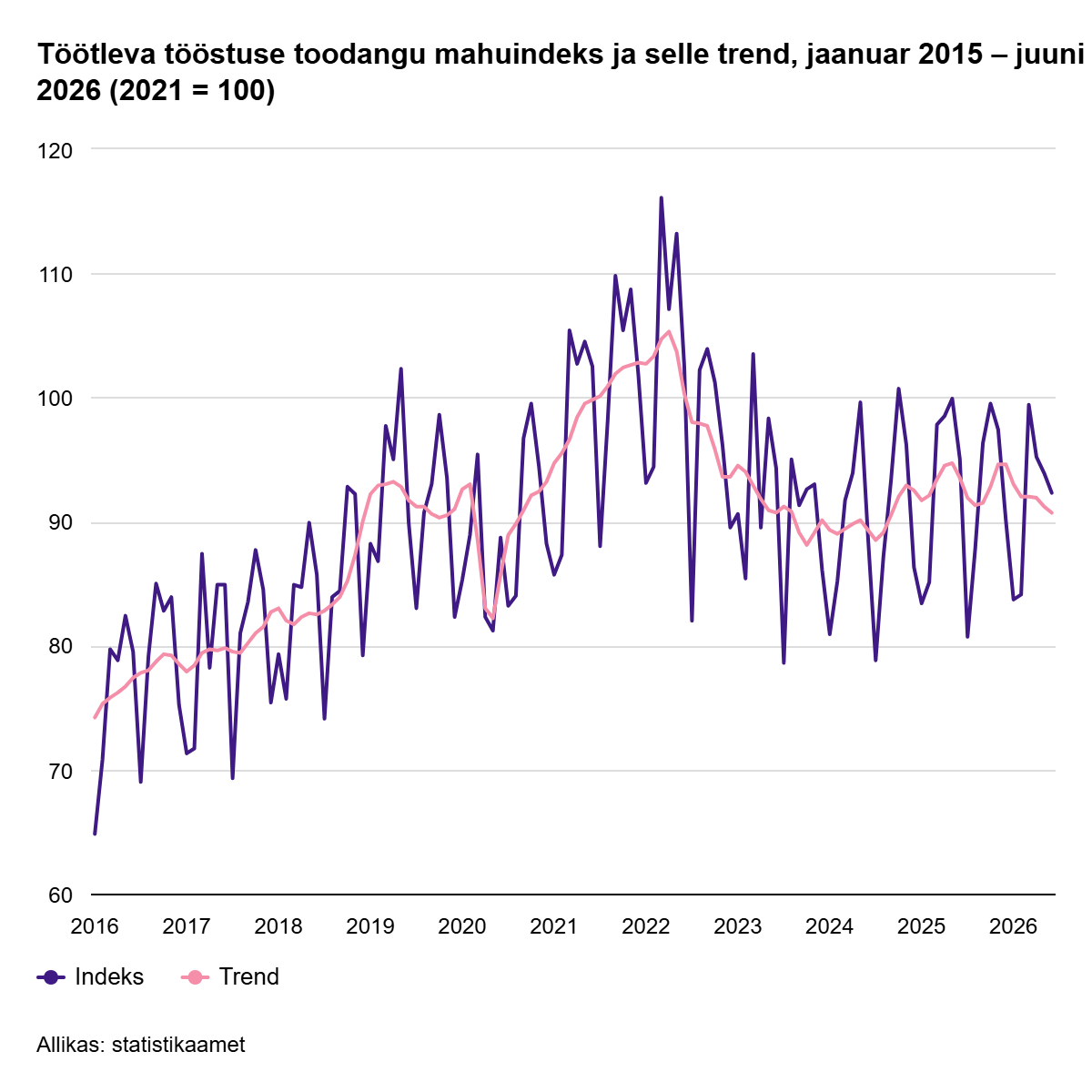

Statistikaameti juhtivanalüütik Riin Kadarik märkis, et töötlevas tööstuses vähenes tootmine viiendat kuud järjest. „Suurim töötleva tööstuse tegevusvaldkond puidutöötlemine kahanes 2%. Juunis vähenes taas ka toiduainete tootmine, mis kahanes 3,3%. Toiduainetööstuse mahud vähenesid võrreldes eelmise aasta sama ajaga kuuendat kuud järjest, kuid juunis võrreldes maiga kahanemine aeglustus,“ tõi Kadarik välja.

Juunis suurenes tootmine ühel kolmandikul töötleva tööstuse tegevusaladel, kahanes aga kahel kolmandikul. Viiest suuremast tegevusalast kahanesid lisaks puidutöötlemisele ja toiduainete tootmisele ka metalltoodete (1,5%) ning arvutite, elektroonika ja optikaseadmete tootmine (13,2%). „Viimast mõjutas sideseadmete ning mõõte-, katse- ja navigatsiooniseadmete tootmise vähenemine,“ selgitas juhtivanalüütik. Sarnaselt maile suurenes aga elektriseadmete tootmine 6,3%.

Toodangu mahu vähenemist mõjutas ka masinate ja seadmete remont ning paigaldus, mille taga oli tsiviillaevade ja -paatide remondi ja hooldusteenuse kahanemine, aga ka mööblitootmise märkimisväärne langus.

Kogu töötleva tööstuse toodangust müüdi 2026. aasta juunis 66,8% välisturule, mais oli see osakaal veidi väiksem.

Võrreldes 2025. aasta juuniga jäi töötleva tööstuse toodangu müük jooksevhindades kalendaarselt korrigeeritud andmetel samale tasemele. Toodangu müük siseturule kahanes 4,4%, müük ekspordiks suurenes aga 2,6%.

260805 Tööstusettevõtete tootmine vähenes juunis viiendat kuud järjest 1

Sesoonselt korrigeeritud andmetel toodeti juunis võrreldes maiga tööstuses kokku 2,3% ning töötlevas tööstuses 0,9% vähem.

Energeetika toodang vähenes juunis püsivhindades 12,6%. Koguseliselt (MWh) kahanes elektri tootmine aastaga 13,1% ja soojuse tootmine 7,1%. „Elektri tootmise vähenemine jätkus peamiselt impordi kasvu tõttu,“ sõnas juhtivanalüütik.

Mäetööstuse 26,7% suurenemise taga oli juunis sarnaselt maiga nii põlevkivi, turba kui ka liiva ja kruusa kaevandamise kasv. „Turba tootmist mõjutasid positiivselt soosivad ilmastikuolud,“ selgitas Kadarik.

260805 Tööstusettevõtete tootmine vähenes juunis viiendat kuud järjest 2

Tööstustoodangu mahuindeks – indeks, mis näitab toodetud tööstustoodangu mahu muutust püsivhindades võrreldes baasperioodiga. Toodangu arvutamiseks püsivhindadesse kasutatakse tootjahinnaindeksit.

Tööstustoodangu müügiindeks – indeks, mis näitab müüdud tööstustoodangu maksumuse muutust jooksevhindades võrreldes baasperioodiga.

Tööstus on suurim majandussektor ja majanduskasvu oluline vedaja. Tööstustoodangu indeks hõlmab kolme sektori ehk mäetööstuse, energeetika ja töötleva tööstuse majandusnäitajaid.

Tööstustoodangu indeksi koostamiseks kogub ja analüüsib statistikaamet andmeid majandus- ja kommunikatsiooniministeeriumi tellimusel, et saada aru, kuidas läheb Eesti majandusel.

Andmed on avaldatud 05.08.2026 seisuga. Näitajad võivad muutuda, kui andmeallikad tagantjärele täpsustuvad.

Kinnisvarakool & koolitus: Varjatud puudused – kinnisvaramaakleri ja müüja vastutus kinnisvaratehingutes

Hepsor AS kavandab võlakirjaemissiooni

HepsorHepsor AS (registrikood 12099216, aadress Järvevana tee 7b, 10112 Tallinn, Eesti; „Hepsor“) plaanib võlakirjade (edaspidi „Võlakirjad“) emiteerimist oma 20 miljoni euro suuruse võlakirjaprogrammi raames. Uus emissioon on kavandatud augusti viimasele nädalale. Pakkumise täpsematest tingimustest ja mahust teavitab Hepsor eraldi.


Võlakirjade netotulu plaanitakse kasutada käimasolevate arendusprojektide rahastamiseks ning uute investeerimisvõimaluste kasutamiseks. Võlakirjad plaanitakse võtta kauplemisele Nasdaq Tallinna börsi Balti võlakirjade nimekirjas. Prospekt ja selle lisa avaldatakse pärast prospekti lisa kinnitamist Finantsinspektsiooni ja Nasdaq Tallinna börsi kodulehel ning Hepsori kodulehel.

Hepsor kaasas sama võlakirjaprogrammi esimese seeria käigus möödunud aasta novembris investoritelt kaheksa miljonit eurot. Emissiooni baasmaht märgiti 1,4 kordselt üle ja selles osales 1079 investorit Eestist ja Lätist.

“Näeme suurt nõudluse kasvu Tallinnas ja Riias uute korterite järele. Meil on hetkel ehituses 513 kodu ning sel aastal plaanime alustada veel kahe elumaja ehitust, kuhu tuleb 119 korterit. Oleme avatud uutele võimalustele elukondliku kinnisvara arendamiseks ning võlakirjade toel finantseerimine toetab meie arendusportfelli jätkuvat kasvatamist. Nii saame reageerida kiiresti olukorras, kus uute projektide käivitamine ning olemasolevate arenduste järgmiste etappide algatamine vajab kapitali,” sõnas Hepsori tegevjuht Martti Krass.

Kinnisvarakool & koolitus: Varjatud puudused kinnisvaratehingutes: ostja õigused, müüja kohustused ja müügigarantii praktikas

EfTEN United Property Fund investeerib Riias asuvasse Domina kaubanduskeskusesse

EfTEN United Property Fund investeerib 2,478 miljonit eurot osaluse omandamiseks ettevõttes SIA EfTEN Domina, mis omab Riias asuvat Domina kaubanduskeskust. Fond omandab ettevõttes 5,9% suuruse osaluse. Varem omas fond Domina keskuses kaudselt 0,71% (ligikaudu 380 tuhande euro) suurust positsiooni läbi EfTEN Kinnisvarafond II AS-i. Tehing on kavas lõpule viia augusti lõpuks. Tehingu tulemusena suureneb kaubanduskinnisvara osakaal fondi portfellis 7 protsendipunkti võrra (47%le).

Domina kaubanduskeskus on üks Riia suurimaid kaubandus- ja vaba aja veetmise keskusi. Keskuses on ligikaudu 42 000 ruutmeetrit üüritavat pinda, 2 000 parkimiskohta ning seal tegutseb 170 erinevat üürnikku. 2023. aastal valmis uus vaba-aja veetmise ala, kuhu muuhulgas rajati kino ning laste mängumaa. Domina keskuse suurimad ja tuntumad üürnikud on Maxima, JYSK, Peek&Cloppenburg, Lido, SkyPark, Sportland, H&M, Apollo Kino ja MyFitness.

Kinnisvarakool: Ehitusjärelevalve praktikas – ehitise ja ehitamise kontrollimine

EfTEN United Property Fund invests in the Domina shopping centre in Riga

EftenEfTEN United Property Fund invests EUR 2.478 million to acquire a stake in SIA EfTEN Domina, which owns the Domina shopping centre in Riga. The fund will acquire a 5.9% equity stake in the company. Previously, the fund held an indirect position of 0,71% (EUR 380 thousand) in the Domina centre through EfTEN Kinnisvarafond II AS. The transaction is expected to be completed by the end of August. As a result of this transaction, the share of retail real estate in the fund’s portfolio increases by 7 percentage points (to 47%).


Domina shopping centre is one of the largest shopping and leisure centres in Riga. The centre has approximately 42,000 square metres of leasable area, 2,000 parking spaces, and is home to 170 different tenants. In 2023, a new leisure area was completed, which includes, among other things, a cinema and a children’s play area. The largest and best-known tenants at the Domina centre are Maxima, JYSK, Peek & Cloppenburg, Lido, SkyPark, Sportland, H&M, Apollo Kino and MyFitness.

Kinnisvarakool: Ehitusjärelevalve praktikas – ehitise ja ehitamise kontrollimine

Hepsor AS plans bond issue

HepsorHepsor AS (registry code 12099216, address Järvevana tee 7b, 10112 Tallinn, Estonia; “Hepsor”) plans to issue bonds (hereinafter the “Bonds”) under its EUR 20 million bond programme. The new issue is planned for the last week of August. Hepsor will provide separate notification regarding the specific terms and volume of the offering.

The net proceeds from the Bonds are planned to be used to finance ongoing development projects and to take advantage of new investment opportunities. The Bonds are planned to be admitted to trading on the Baltic Bond List of Nasdaq Tallinn Stock Exchange. The prospectus and its supplement will be published on the websites of the Financial Supervision Authority, Nasdaq Tallinn Stock Exchange and Hepsor after the approval of the prospectus supplement by the Financial Supervision Authority.

Under the first series of the same bond programme last November, Hepsor raised eight million euros from investors. The base volume of the issue was oversubscribed by 1.4 times, with 1,079 investors from Estonia and Latvia participating.

“We see significant growth in demand for new apartments in Tallinn and Riga. We currently have 513 homes under construction, and this year we plan to start construction of two more residential buildings with 119 apartments. We are open to new opportunities for residential real estate development, and bond financing supports the continued growth of our development portfolio. This allows us to react quickly in situations where launching new projects and initiating the next phases of existing developments requires capital,” said Martti Krass, CEO of Hepsor.

Kinnisvarakool & koolitus: Ehituslepingute sõlmimine, muutmine ja lõpetamine – praktikas esinevad probleemid

EfTEN: Finantsinspektsioon kooskõlastas EfTEN United Property Fund tingimuste muudatused

EftenEfTEN Capital AS-i juhatus kinnitas oma 26.06.2026 otsusega EfTEN United Property Fund’i (edaspidi Fond) tingimuste uuendatud redaktsiooni. Finantsinspektsioon kooskõlastas Fondi tingimuste muudatused 03.08.2026.

Fondi tingimustes täiendati osakute väljalaskmishinna sõnastust punktis 4.5. Muudatus võimaldab edaspidi lasta Fondi osakuid välja lisaks osaku puhasväärtusele ka osaku viimase 60 kuni 90 kauplemispäeva aritmeetilise keskmise sulgemishinnaga väärtpaberiturul, kus Osakud on noteeritud. Muid tingimusi ei muudetud.

Fondi tingimuste muutmisega ei muudeta Fondi investeerimispõhimõtteid ega ka Fondi arvel makstavate tasude ja kulude loetelu ega nende arvutamise korda ja piirmäärasid. Samuti ei muudeta põhimõtteid osakute tagasivõtmise osas. Fondi tingimuste muudatuste näol on tegemist osaliselt tingimuste olulise muutmisega IFS § 38 lg 2 mõttes. Fondi tingimuste oluliseks muutmiseks on täidetud IFS § 38 lg 4 punktis 2 sätestatud tingimus.

EfTEN United Property Fund’i muudetud tingimused hakkavad kehtima üks kuu peale nende avalikustamist, ehk 04.09.2026.

EfTEN United Property Fund’i muudetud tingimused on leitavad fondi kodulehel: https://eftenunitedpropertyfund.ee/aruanded-ja-dokumendid/

Kinnisvarakool & koolitus: Varjatud puudused – kinnisvaramaakleri ja müüja vastutus kinnisvaratehingutes

15.09.2026 toimub koolitus ostja õigustest, müüja kohustustest ja müügigarantiist kinnisvaratehingutes

Martina ProosaKoolitus „Varjatud puudused kinnisvaratehingutes: ostja õigused, müüja kohustused ja müügigarantii praktikas“ on praktiline koolitus kõigile, kes soovivad paremini mõista kinnisvaratehingute järel tekkivaid puudustega seotud vaidlusi ning nendega seotud õigusi ja kohustusi. Koolitus annab selge ülevaate varjatud puuduse mõistest, ostja õiguskaitsevahenditest, müüja vastutuse piiridest, müügigarantii tähendusest ja olulisemast kohtupraktikast.

Koolitusel saad:

  • aru, millal on tegemist varjatud puudusega ja millal mitte;
  • teada, millised on ostja õigused puuduse avastamisel;
  • praktilise ülevaate müüja vastutuse piiridest ja müügigarantii sisust.

Koolitaja on ehitus- ja planeerimisvaldkonna jurist Martina Proosa. Koolitus toimub 15.09.2026 kell 10.00–15.15 ning viiakse läbi MS Teamsi keskkonnas.

Lisateave ja registreerumine

Registreeru koolitusele: +372 525 6655, kool@kinnisvarakool.ee või kodulehel.

Margot Toompark
Kinnisvarakool OÜ
Koolituste müük ja korraldus
+372 525 6655
kool@kinnisvarakool.ee
www.kinnisvarakool.ee

Kinnisvarakool OÜ

Kinnisvarakool & koolitus: Kinnisvara hindamise ABC – põhimõtted, meetodid ja turuväärtus

Statistika: Tallinna korteritehingute hind suunab Eesti keskmist

Tõnu Toompark, Kinnisvarakooli konsultant ja koolitaja

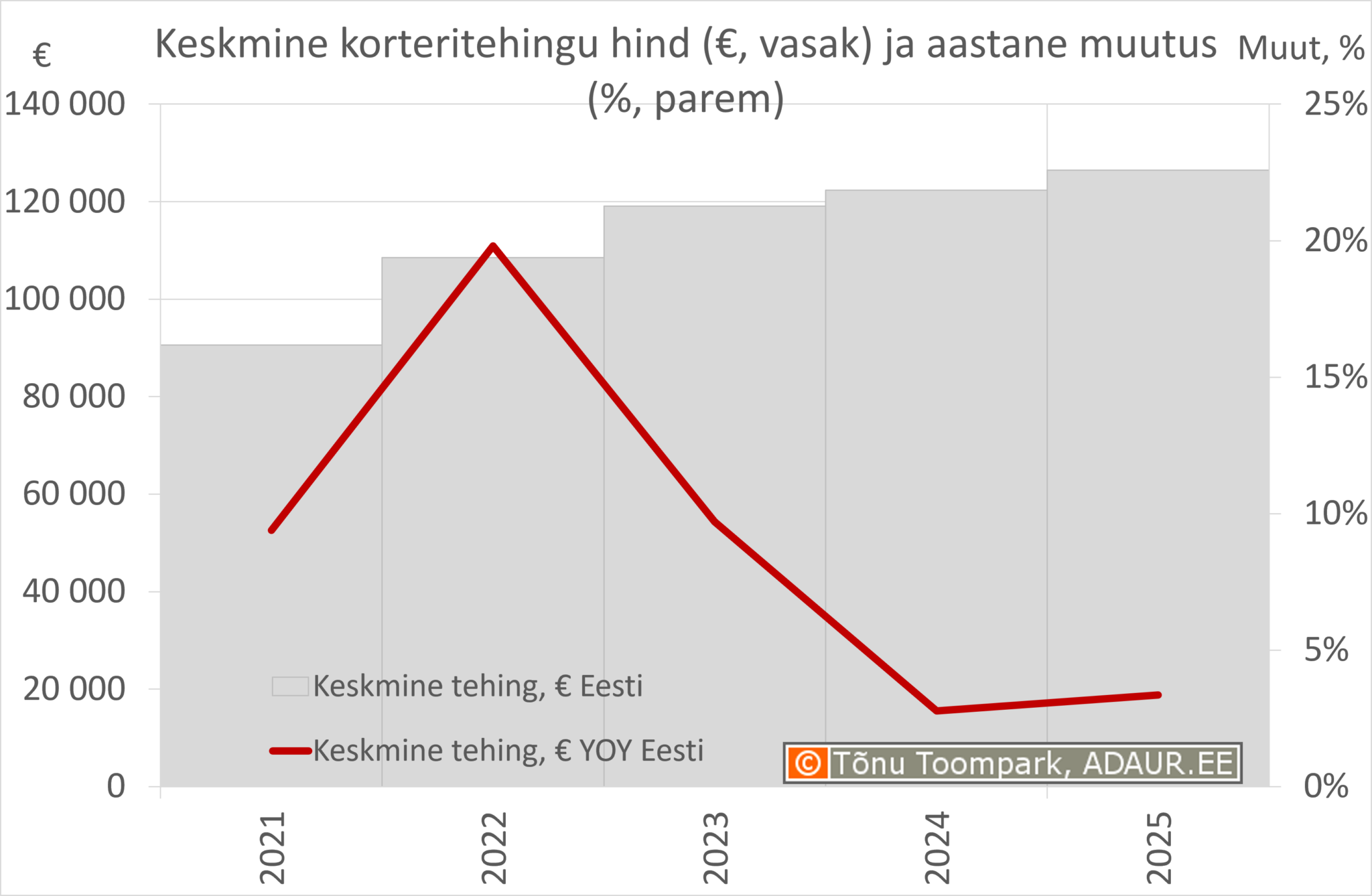
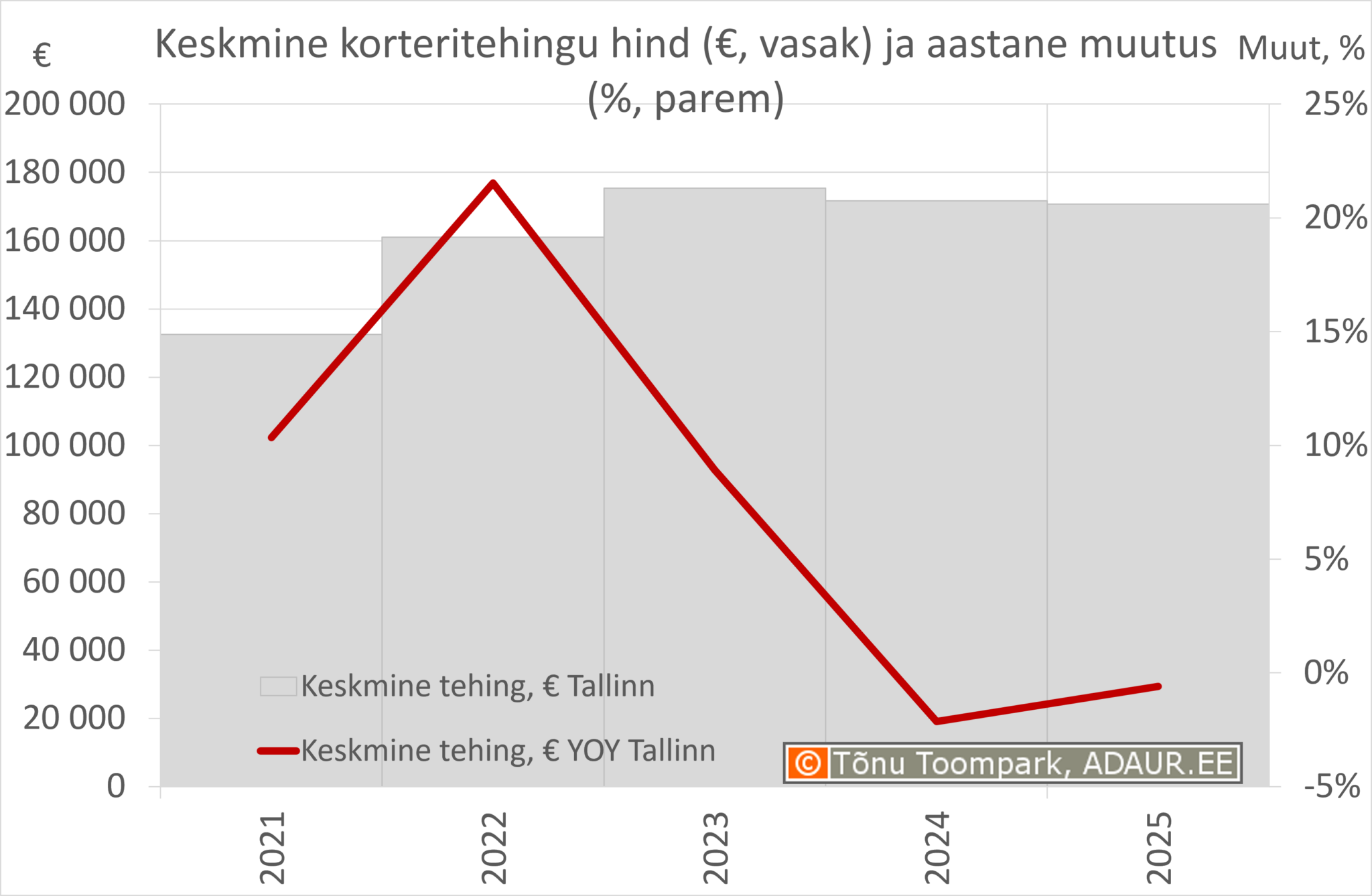
Eesti korteritehingute 2025. aasta keskmine hind oli maa- ja ruumiameti andmetel 126 500 eurot, Tallinna tehing 162 500 eurot. Aasta varasemaga võrreldes kerkis Eesti keskmine korteritehingu hind 3,4% ja Tallinnas vähenes 0,6%.

Eesti keskmine korteritehingu koguhind on viimastel aastatel järjekindlalt astunud samm sammu järel ülespoole. Hinnatõusu taga on osalt olnud inflatsioon kinnisvarahindades ehk üldine hinnatõus.

Teisalt mõjutab Eesti keskmist hinda tehingute arvu piirkondlik jagunemine. Tallinna kui Eesti kõige kallima korterituru piirkonna 2022. a korteritehingute arv 9662 tehingut moodustas Eesti tehingute koguarvust 38%. 2025. aastaks suurenes Tallinna tehingute osakaal 42% peale.

Tallinna korteritehingute osakaalus suurenemine on üks oluline põhjus, miks vaatamata Tallinna korteritehingute keskmise koguhinna vähenemisele Eesti keskmine hind siiski kasvas.


Kõigi graafikute vaatamiseks kliki siin: KINNISVARATURG GRAAFIKUTES!

Soovid nõustamist siin kommentaaris toodud või muudel kinnisvaravaldkonna teemadel? Kontakteeru palun +372 525 9703 või tonu@toompark.ee (Tõnu Toompark).

Tõnu Toompark on Adaur Grupp OÜ ja Kinnisvarakool OÜ juhatuse liige ning Eesti Kinnisvarafirmade Liidu (EKFL) ja Eesti Omanike Keskliidu juhatuse liige.

Adaur Grupp OÜ

Kinnisvarakool

Eesti Omanike Keskliit / EOKL

Eesti Kinnisvarafirmade Liit

Kinnisvarakool & koolitus: Ehitamise dokumenteerimine praktikas – kuidas vältida vaidlusi, järelevalve märkusi ja probleeme objekti üleandmisel?

EfTEN: FSA approved the amended fund rules of EfTEN United Property Fund

EftenThe Management Board of EfTEN Capital AS approved the updated version of the terms and conditions of EfTEN United Property Fund (hereinafter referred to as the Fund) by its decision of 26.06.2026. The Financial Supervision Authority approved the amendments to the Fund’s terms and conditions on 03.08.2026.

In the fund’s terms and conditions, the wording regarding the issue price of units was amended in clause 4.5. Going forward, the Fund’s units may be issued not only at the net asset value of the unit, but also at the arithmetic average of the closing prices over the last 60 to 90 trading days on the securities market on which the units are listed. No other changes to terms and conditions have been made.

The amendment of the Fund’s terms and conditions does not change the Fund’s investment principles, nor the list of fees and expenses payable on the Fund’s account or the procedure and limits for calculating them. The principles regarding the redemption of units are also unchanged. The amendments to the Fund’s terms and conditions partially constitute a material change of the terms and conditions within the meaning of § 38(2) of the Investment Funds Act (IFS). For the purposes of a material change of the Fund’s terms and conditions, the condition set out in § 38(4) point 2 of the IFS is fulfilled.

The updated fund rules of EfTEN United Property Fund will come into force one month after their publication, on 04.09.2026.

The updated fund rules of EfTEN United Property Fund can be found on the fund’s website: https://eftenunitedpropertyfund.ee/en/reports-documents/

Kinnisvarakool: Ehitusjärelevalve praktikas – ehitise ja ehitamise kontrollimine

Swedbank: Hinnad juulis mõnevõrra tõusid

SwedbankTuristide kulutusi arvesse võttev harmoneeritud hinnaindeks tõusis juulis möödunud kuuga võrreldes 0,5% võrra. Kuise hinnatõusu taga oli eelkõige kommunaal- ja turismiteenuste kallinemine. Vee- ja prügiteenuste hinnad kasvasid ning suve alguses kallinesid nii majutus- kui ka toitlustusteenused.
Aastaga tõusid hinnad vaid 2%. Inflatsiooni aeglustumise taga on kevadkuudega võrreldes eelkõige toiduhindade langus. Poeketid on teinud müügi hoogustamiseks erinevaid allahindluskampaaniaid ning ulatuslikud jaanipäeva soodusmüügid avasid tarbijate rahakoti – toiduainete müügimaht kasvas juunis esimest korda rohkem kui kahe aasta jooksul.

Sõjategevuse hoogustumine kergitas nafta hinda

Juuli teises pooles ägenes taas sõda Lähis-Idas. Lisaks Hormuzi väinale võeti tankerid sihikule ka Punasel merel. Ukraina rünnakud Venemaa energiataristu pihta vähendasid naftatoodete pakkumist maailmaturul veelgi. Julgeolekuolukord on ebakindel ja iga uus uudis võib nafta hinda muuta. Juulikuu lõpus oli Brent toornafta hind 90 dollarit. See on kõrgem kui juuni lõpus, kuid jääb siiski allapoole Lähis-Ida sõja alguse tasemest, 110 dollarit barrelist.

Juulis tõusis maagaasi hind Euroopa turul võrreldes juuniga ligikaudu viiendiku võrra. Hinnatõusu põhjustas eelkõige Lähis-Ida geopoliitiliste riskide suurenemine. Euroopa gaasihoidlad on külma talve tõttu tavapärasest tühjemad ning konkurents Aasiaga veeldatud maagaasi pärast on varasemast tugevam.

Sel aastal tõusevad hinnad ligi 4%

Swedbank prognoosib selleks aastaks ligi 4% inflatsiooni. Järgmise aasta hinnatõus peaks jääma 3% juurde. Hinnatõusu annab sel aastal suurima panuse energia ja transpordi kallinemine.

Kinnisvarakool & koolitus: kinnisvaramaakleri täiendkoolitus

KIK lõpetas Loodusmuuseumi riigihanke kontrollimenetluse

Keskkonnainvesteeringute keskus KIKKIK lõpetas Euroopa Liidu Ühtekuuluvusfondist rahastatud Eesti Loodusmuuseumi püsiekspositsiooni projekteerimis- ja ehitustööde riigihanke kontrollimenetluse. Kontrolli käigus tekkinud riigihangete seaduse rikkumise kahtlus ei leidnud ärakuulamismenetluses esitatud täiendavate tõendite põhjal kinnitust ning seetõttu puudub alus finantskorrektsiooni kohaldamiseks.
KIKi toetuste rakendamise üksuse juht Sirli Vaksmann ütles, et KIK kontrollib Euroopa Liidu toetuste rakendusüksusena toetatavate projektide puhul, kas riigihanked on läbi viidud kooskõlas toetuse kasutamise tingimuste ja riigihangete nõuetega. „Käesolev kontroll viidi läbi KIKi tavapärase järelevalvetegevuse raames. Riigihanke korraldas Eesti Loodusmuuseum kui projekti partner ning KIK kontrollis hanget Euroopa Liidu toetuste rakendusüksusena. Projekti elluviija on Kliimaministeeriumi kliimaosakond,“ selgitas ta.

Täiendavad tõendid ei kinnitanud rikkumise kahtlust

Kontrolli käigus leidis KIK esialgu, et ehitustööde projektijuhi ühe referentsobjekti puhul ei nähtu esitatud dokumentidest hanke tingimustes nõutud kande- ja välispiirete ehitamise või rekonstrueerimise töid. Seetõttu alustati ärakuulamismenetlust.

Esialgne hinnang tugines ehitusloa aluseks olnud eelprojekti dokumentidele. Ärakuulamismenetluse käigus esitas Eesti Loodusmuuseum täiendavad dokumendid ja selgitused, sealhulgas tööprojekti arhitektuurse osa seletuskirja, ehituskonstruktsioonide projekti, ehitaja kinnituse ning täiendava teabe tehtud ehitustööde kohta. „Esitatud materjalidest selgus, et projekteerimise käigus oli tehnilist lahendust täpsustatud ning tööprojekt nägi ette ka kandekonstruktsioonide muudatused ja välispiirete ümberehitamise. Seetõttu vastas edukaks tunnistatud pakkuja projektijuhi kogemus hankes kehtestatud nõuetele ning riigihangete seaduse rikkumine ei leidnud tõendamist. Sellest tulenevalt puudub ka alus finantskorrektsiooni kohaldamiseks,“ lausus Vaksmann.

Lõplik otsus tugines kõigile menetluses esitatud tõenditele

Vaksmanni sõnul tehakse kontrollimenetluses lõplik otsus alati alles pärast seda, kui on hinnatud nii olemasolevaid dokumente kui ka toetuse saaja esitatud selgitusi ja täiendavaid tõendeid. „Käesolevas menetluses võimaldasid ärakuulamismenetluse käigus esitatud täiendavad dokumendid hinnata referentsobjektil tehtud ehitustöid terviklikult. Nende põhjal ei leidnud esialgne rikkumise kahtlus tõendamist ning kontrollimenetlus lõpetati finantskorrektsiooni kohaldamata,“ lisas ta.

Mida KIK kontrollis?

KIK kontrollis Euroopa Liidu toetuste kasutamise järelevalve käigus, kas edukaks tunnistatud pakkuja vastas hankes kehtestatud tingimustele.

Esialgne hinnang põhines kontrolli ajal KIKile kättesaadavatel dokumentidel. Ärakuulamismenetluse käigus esitatud täiendavad dokumendid võimaldasid aga hinnata referentsobjektil tehtud ehitustöid terviklikult ning nende põhjal ei leidnud rikkumise kahtlus tõendamist.

Taust

  • KIK täidab Euroopa Liidu toetuste rakendusüksusena seadusest tulenevat ülesannet kontrollida toetuste kasutamise õiguspärasust.
  • Riigihangete kontroll on osa KIKi tavapärasest järelevalvetegevusest Euroopa Liidu toetuste rakendamisel.
  • Kontrollimenetluses hinnatakse nii hankedokumente kui ka toetuse saaja esitatud selgitusi ja täiendavaid tõendeid.
  • Ärakuulamismenetluse eesmärk on anda toetuse saajale võimalus esitada enne lõpliku otsuse tegemist oma seisukohad ning täiendavad tõendid.
Kinnisvarakool: Planeerimis-ehitusvaldkonna spetsialisti täiendõppeprogramm